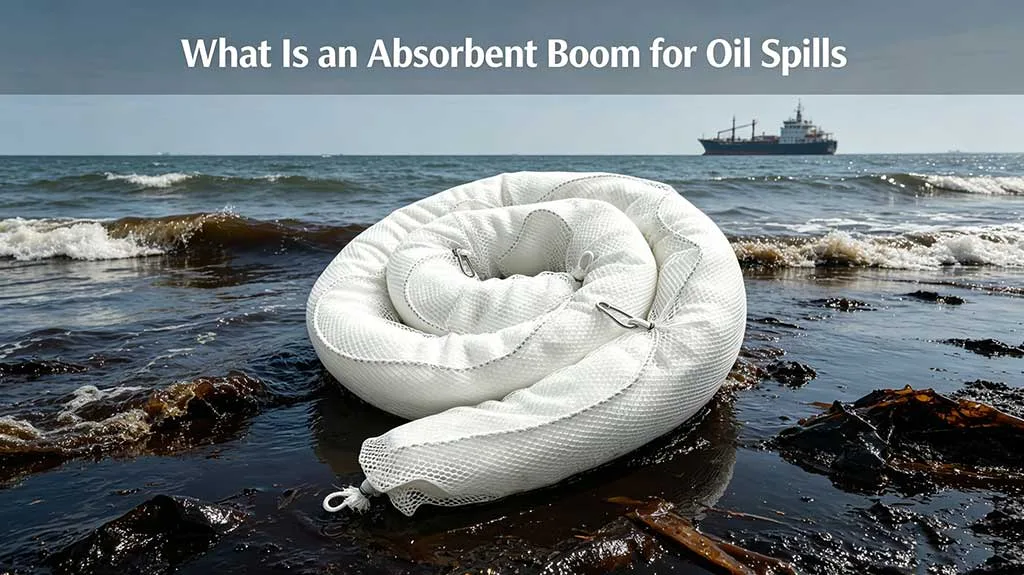
An absorbent boom for oil spills is a flexible, floating industrial spill control tool designed to contain, block, and absorb hydrocarbon leaks on water and land, serving as the first line of defense for industrial oil spill emergency management. Unlike disposable absorbent pads or local cleaning tools, oil spill booms focus on spill interception first, absorption second, solving the most troublesome problem in industrial spill disposal: rapid oil diffusion that leads to large-area pollution and compliance risks.
With years of on-site industrial spill cleanup auditing and product testing experience, I’ve seen countless factories face environmental fines and costly cleanup losses due to delayed or incorrect boom usage. This guide breaks down every detail of oil spill booms, from basic definitions and working mechanisms to scenario applications and mistake avoidance, helping businesses achieve efficient, EPA-compliant spill control.
🌊 What Is an Absorbent Boom for Oil Spills? Core Definition & Key Features
Many industrial facility managers confuse absorbent booms with traditional containment booms, but the two tools have essential functional differences that directly determine spill disposal results. An absorbent boom for oil spills is a tubular, flexible spill control device made of hydrophobic oleophilic synthetic fibers, mainly polypropylene and polyester, featuring dual functions of physical interception and oil adsorption. It is widely used in factories, harbors, rivers, and sewage facilities to control diesel, engine oil, crude oil, and solvent spills.
Based on real product testing and on-site usage verification, qualified industrial oil spill booms have four non-negotiable core features that distinguish them from low-quality ordinary booms:
- Absolute hydrophobic performance: Repels all water while exclusively adsorbing oil and hydrocarbon solvents, avoiding saturation failure caused by water mixing, even in running water environments
- Splicable barrier structure: Equipped with stable end connectors to link multiple booms into a continuous, seamless barrier, eliminating spill leakage gaps
- Harsh environment adaptability: Wear-resistant outer casing prevents fiber shedding and tearing, suitable for outdoor wind, wave, and ground friction scenarios
- Standard floating performance: Maintains stable floating on static and flowing water surfaces without sinking after absorbing oil, ensuring a continuous interception effect
A common misconception among factory operators is that all floating booms work the same. In fact, pure containment booms only block oil spread without absorption capacity, requiring secondary manual cleanup, while professional absorbent booms integrate interception and adsorption to cut cleanup workload by nearly half.
⚙️ How Does an Absorbent Boom Stop Oil Spill Leaks? Complete Working Mechanism
To master the usage of an oil spill boom, you first need to understand its complete leak-stopping logic. Most users only know it can block oil spills but ignore its layered working principle, leading to incomplete spill control in complex scenarios. The leak-stopping process of an absorbent boom for oil spills is divided into three linked steps, forming a closed-loop defense against oil diffusion.
1. Physical Barrier Interception: Block Diffusion Paths Instantly
Once deployed, the flexible tubular boom forms a closed or semi-closed isolation zone. On water surfaces, it floats stably to block floating oil from spreading with water flow; on flat factory ground, it surrounds leakage points to prevent oil from flowing to floor drains, equipment gaps, or pedestrian passages. This step controls the spill range within 1–3 minutes, fundamentally avoiding large-area pollution.
2. Selective Oil Adsorption: Lock Hydrocarbon Pollutants Rapidly
The internal high-density polypropylene fiber material has strong oleophilic and hydrophobic properties. It quickly captures and adsorbs various industrial oils and organic solvents, including diesel, engine oil, paraffin, benzene, and toluene. Unlike ordinary cotton absorbents, it does not absorb rainwater, sewage, or cleaning water, ensuring stable adsorption efficiency in humid environments.
3. Stable Oil Locking: Prevent Secondary Leakage
After full saturation, the boom’s compact fiber structure locks internal oil molecules tightly without dripping or leakage during handling and transportation. This avoids secondary pollution caused by loose oil spillage during cleanup, meeting industrial secondary pollution prevention standards.
From years of on-site experience, the biggest advantage of oil spill booms over other absorbents is timeliness. In sudden large-volume spills, booms can complete range interception faster than pads and pillows, buying sufficient time for subsequent thorough cleanup.
📋 Main Types of Absorbent Booms for Oil Spills & Scenario Matching
Not all oil spill booms fit every scenario. Mismatched boom types lead to poor leak-stopping effects and wasted costs. Combined with ASTM F 726 industrial absorbent testing standards and long-term factory service experience, I sorted out mainstream oil spill boom types, specifications, and applicable scenarios for quick user selection.
Boom Type | Core Specifications | Key Advantages | Best Application Scenarios | Usage Limitations |
|---|---|---|---|---|
Standard Floating Oil Boom | 20cm diameter × 3m length, 4 pcs per case | Large adsorption capacity, stable floating, suitable for flowing water | Rivers, harbor waters, factory sewage pool large-area spills | Bulky, not for indoor small spills |
Double Tube Oil Boom | Dual 10cm diameter × 3m length, lightweight design | Flexible deployment, easy storage, and low transportation cost | Small and medium water surface spills, shoreline edge protection | Limited single adsorption capacity |
Mini Oil Boom | 7.5cm diameter × 121cm length, portable size | Flexible bending, no space restriction, fast deployment | Indoor factory ground leaks, pipeline gap spill interception | Not applicable for large-volume water spills |
High-Capacity Folded Boom | 12cm × 15m folded size, multi-format conversion | Dual-purpose for boom/pillow/sheet use, high cost performance | Mixed land-water spill scenarios, emergency flexible disposal | Requires manual unfolding and arrangement |
In actual factory inspections, double-tube booms and folded booms are the most cost-effective choices for most small and medium-sized enterprises, balancing emergency response efficiency and daily storage convenience. Large manufacturing and petrochemical enterprises are recommended to equip standard floating booms for outdoor water spill prevention.
🏭 Top Industrial Use Cases for Oil Spill Absorbent Booms
Many users only deploy booms during sudden spills but ignore their daily preventive application value. Qualified oil spill booms can achieve both emergency leak stopping and daily risk prevention, covering all high-risk industrial spill scenarios.
1. Outdoor Water Surface Spill Control
Factory sewage pools, cooling water ponds, and adjacent river sections are high-risk areas for floating oil pollution. Deploying spliced floating booms around water bodies can intercept floating oil generated by equipment leakage or rainwater scouring, preventing oil from spreading to public water areas and triggering environmental supervision penalties.
2. Factory Ground Large-Area Spill Interception
For sudden large-area oil spills on production workshop floors and outdoor storage yards, oil booms can quickly surround the spill range to stop oil from flowing to floor drains and underground pipe networks. This is the most effective way to avoid hidden underground pollution risks that are difficult to clean up.
3. Oil Storage Area Fixed-Point Protection
Placing mini booms and double-tube booms around oil storage barrels, oil tank bottoms, and pipeline valve joints can cope with long-term micro-leakage and occasional dripping, realizing 24-hour passive spill prevention and reducing daily manual cleaning frequency.
4. Emergency Spill Drill & Compliance Reserve
As standard equipment for industrial environmental safety reserves, oil spill booms match other absorbent tools to form a complete emergency disposal system, meeting factory safety inspections and regular spill drill requirements, and ensuring rapid response capability in unexpected leakage accidents.
❌ Common Oil Boom Usage Mistakes That Cause Leakage Failure
Based on on-site rectification experience of over 100 industrial factories, more than 60% of spill disposal failures are caused by incorrect boom usage rather than product quality problems. The following four common mistakes are easy to ignore but directly lead to poor leak-stopping effects and secondary pollution.
- Incomplete splicing and gap leakage: Many users simply place booms side by side without docking and fixing connectors. Water flow and ground friction will create gaps, causing oil to escape from the joints. Overlapping and locking connectors is essential for deployment.
- Mismatched scenario selection: Using mini booms for large-area water spills leads to insufficient interception range; using bulky standard booms for indoor small leaks causes inconvenient operation and waste of resources.
- Ultra-limit service reuse: Continuing to use saturated booms leads to oil dripping and secondary leakage. Saturated booms completely lose oil-locking capacity and must be replaced and disposed of in a timely manner.
- Improper storage damaging performance: Long-term exposure to sunlight and humid environments destroys the fiber’s hydrophobic structure, reducing adsorption capacity by more than 30% and failing to repel water during use.
✅ Expert Pro Tips for Maximizing Oil Boom Leak-Stopping Effect
To help users give full play to the performance of absorbent booms for oil spills and achieve zero-leakage spill control, I summarize practical operation skills accumulated from long-term on-site disposal and product testing:
- Anchor fixation for water deployment: When using booms on flowing water, such as rivers and ponds, anchor both ends of the boom to avoid drifting with the water flow and failure of interception
- Combined matching for complex spills: For large-scale mixed spills, adopt the combination of “boom interception + pad adsorption + pillow centralized cleanup” to improve overall disposal efficiency
- Regular inspection and replacement: Check stored booms quarterly for fiber aging and damage, and replace expired products in time to ensure emergency availability
- Standard waste disposal: Dispose of used oil-contaminated booms in accordance with local industrial waste regulations; qualified products can be incinerated with low ash residue to reduce disposal costs
🔗 Authoritative Industry Guidelines for Standard Oil Spill Boom Usage
To ensure factory oil spill disposal operations are standardized, compliant, and safe, the selection and use of absorbent booms for oil spills must refer to international authoritative testing and industry regulatory standards, avoiding non-compliant operations that trigger supervision risks.
The U.S. Environmental Protection Agency (EPA) releases standardized industrial oil spill prevention and disposal specifications, clarifying the selection criteria, deployment standards, and waste disposal requirements of oil spill containment tools. Factories can refer to the EPA’s official environmental protection guidelines to optimize boom deployment schemes and meet industrial environmental compliance standards.
Meanwhile, 3M’s authoritative petroleum sorbent technical bulletin formulates unified performance testing standards for oil absorbent products based on ASTM F 726 industrial specifications, verifying the adsorption capacity, hydrophobic performance, and scenario applicability of different types of oil booms. Users can check the 3M Petroleum Sorbent Technical Guide to obtain accurate product parameter references and select compliant boom products.
🔚 Final Verdict: Core Value of Absorbent Boom for Oil Spills
An absorbent boom for oil spills is an irreplaceable core tool in industrial oil spill emergency control, relying on its dual advantages of physical interception and selective adsorption to solve the core pain point of oil diffusion in spill disposal. Different types of oil spill booms correspond to diverse scenarios such as water surface spills, ground large-area leaks, and fixed-point micro-leakage protection. Correct selection and standardized deployment can effectively improve factory spill disposal efficiency, avoid environmental compliance penalties, and reduce long-term operational safety risks.
For industrial factories pursuing standardized environmental safety management, oil spill booms are not only emergency cleanup tools but also key preventive equipment for daily risk control. Matching suitable boom products according to actual spill scenarios and adhering to authoritative industry usage standards can build a comprehensive, efficient, and compliant factory oil spill prevention and control system. If you need scenario-matched oil spill boom solutions and full-set industrial spill emergency equipment consulting, our professional team can provide one-stop customized technical support.