Industrial absorbents are fundamental supplies to handle industrial spills, maintain workspace hygiene, and protect staff safety across factories, workshops, and marine facilities. Many facility managers and maintenance teams often wonder whether microfiber products can replace professional spill control materials for daily and emergency use. While microfiber items are widely used for regular cleaning tasks, they cannot fully meet the demands of large-scale oil, coolant, and chemical spills.
This guide deeply explores the features of microfiber, contrasts it with professional industrial absorbents, and elaborates on the functions, application scenarios, and selection tips of absorbent pads and absorbent booms, helping you build a reliable spill management system. Every commercial and industrial site faces potential liquid spill risks, ranging from tiny daily drips to sudden large-volume leaks. Picking up improper cleaning materials will not only slow down cleanup work but also trigger slip hazards, environmental pollution, and violations of safety regulations.
Understanding the differences between common absorbent materials is the first step to making wise purchasing and usage decisions. In the following content, we will analyze material characteristics, applicable scenarios, pros and cons, and practical selection principles to help you match the right products to different spill control needs.
🔎 Basic Knowledge: How Does Microfiber Perform in Liquid Absorption
Before comparing different spill control tools, it is necessary to figure out the absorption principle and actual performance of microfiber, one of the most common cleaning materials on the market. Many users search online to confirm whether microfiber has a strong absorption capacity, and the answer is definite.
- Material structure of microfiber
- Made from blended synthetic fibers, including polyester and polyamide
- Fibers are split during production to form countless tiny gaps
- An enlarged surface area greatly enhances the ability to capture and lock liquids and fine particles
- Core advantages of microfiber
- Can absorb liquid several times of its own weight
- Soft texture, will not scratch equipment surfaces
- Reusable after simple washing, economical for long-term daily use
- Main application ranges for standard microfiber products
- Daily surface wiping and equipment cleaning
- General janitorial work in the office and public areas
- Surface polishing for automotive and mechanical parts
- Routine cleaning tasks in healthcare environments
Microfiber indeed delivers excellent performance in conventional cleaning work. But a key question arises for industrial operators: are microfiber towels reliable enough to cope with on-site emergency spills? The answer depends entirely on the spill type, liquid volume, and usage environment.
🧼 Microfiber Towels: Ideal Use Cases and Limitations for Industrial Settings
Microfiber towels have become a staple tool in most industrial workshops thanks to their reusability and low cost. They shine in regular maintenance work, yet show obvious drawbacks when facing emergency spill response.
- Best scenarios to use microfiber towels
- Wiping residual oil and coolant from mechanical surfaces after operation
- Cleaning small isolated drips around workstations and tool benches
- Polishing metal, plastic, and painted surfaces without causing damage
- Daily sanitation maintenance in low-risk work zones
- Key limitations for industrial spill control
- Limited total absorption capacity, unable to handle large-volume liquid leaks
- Not professionally designed for chemical and hazardous liquid containment
- Difficult to completely isolate spreading liquids during sudden spills
- Repeated use with chemical or oily waste may bring hidden safety risks
For daily minor cleaning and tiny drips, microfiber towels are a cost-effective and convenient choice. Once the spill involves bulk oil, industrial solvents, or corrosive chemicals, professional industrial absorbents will become an irreplaceable solution to guarantee on-site safety.
🛡️ Overview of Professional Industrial Absorbents and Core Classifications
Professional industrial absorbents are specially engineered for industrial spill prevention, emergency cleanup and liquid containment. Different from ordinary cleaning cloths, these materials focus on rapid absorption, safe containment, and standardized disposal, fully complying with industrial safety and environmental protection rules.
- Three mainstream types of industrial absorbents and their targeted liquids
- Universal absorbents: Compatible with water, engine oil, cutting coolant, and most common industrial fluids, fit for mixed spill scenarios in general workshops
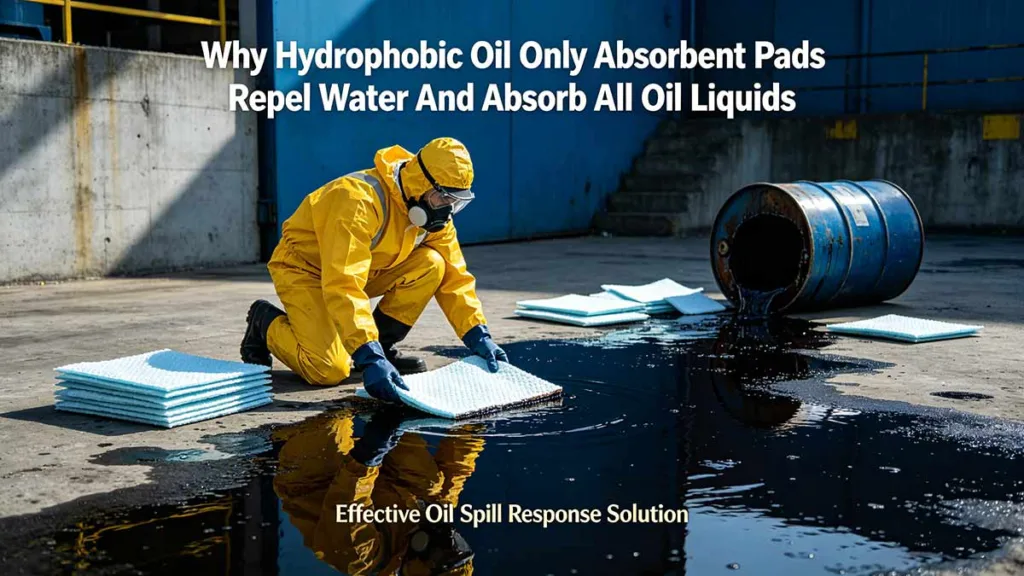
- Oil-only absorbents: Exclusive for petroleum-based liquids such as crude oil, diesel, and lubricants, with water-repellent performance, widely used in marine, automobile, and oil-related industries
- Chemical absorbents: Made to deal with corrosive, acidic, alkaline, and unknown hazardous chemicals, essential for laboratories, chemical processing plants, and high-risk production lines
- Shared features of professional industrial absorbents
- Fast liquid locking effect to prevent secondary spreading
- High bearing capacity for large-volume spills
- Single-use design to avoid cross-contamination of hazardous substances
- Standard size and shape for quick deployment in emergencies
Many facility managers ask how to allocate different types of absorbents reasonably. The core rule is to classify risks first: confirm the main liquid types on site, and then configure matched industrial absorbents in different work areas. This classified deployment mode can maximize the efficiency of spill response.
🧻 Absorbent Pads: The Primary Barrier for On-Site Spill Prevention and Cleanup
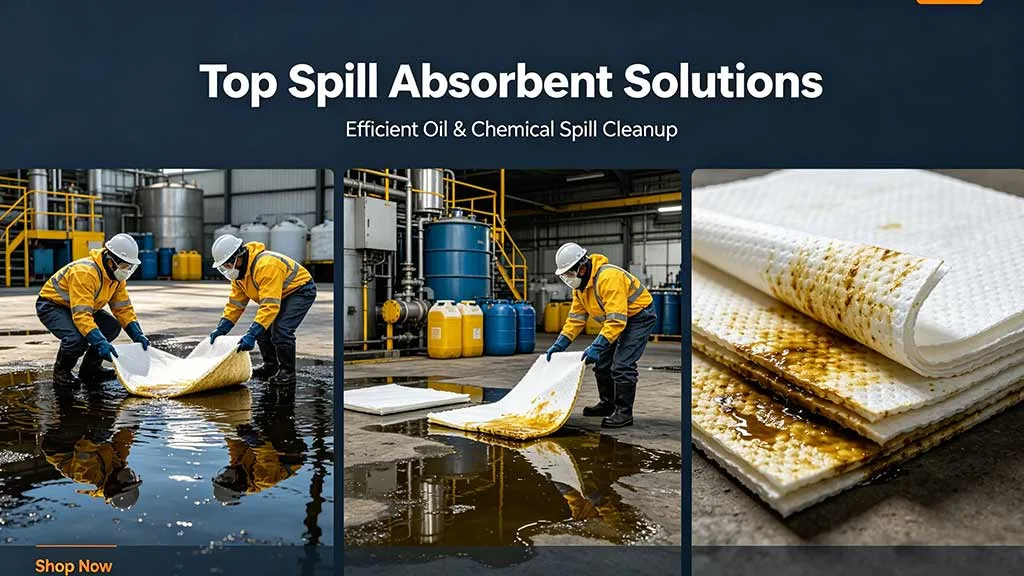
Absorbent pads are the most widely used category among industrial absorbents. Their flat sheet structure, lightweight feature, and diverse specifications make them the first choice for daily spill prevention and rapid emergency treatment in almost all industrial sites.
- Standout strengths of absorbent pads
- Ultra-fast absorption speed to reduce slip and fall risks in high-traffic areas
- Stable liquid retention performance, not easy to leak after absorbing liquids
- Simple and labor-saving disposal process after use
- Multiple sizes and thickness grades to meet different load demands
- Flexible placement for pre-protection and emergency use
- Common deployment positions for absorbent pads
- Placed under running machinery and leaking pipelines for long-term drip collection
- Arranged near loading docks, transit passages, and busy work areas
- Equipped with standard spill kits for portable emergency response
- Laid on warehouse floors and storage areas where fluid leakage may occur
Compared with microfiber towels, absorbent pads are developed purely for industrial spill control and safety compliance. When facing engine oil, fuel, and various industrial chemicals, their absorption efficiency and safety performance are far better than those of ordinary cleaning cloths. For sites with frequent small and medium spills, stocking sufficient absorbent pads is the most basic and effective safety measure.
🚧 Absorbent Booms: Professional Tools for Large-Scale Spill Containment
When liquid spills expand to a wide range or flow along ground, water surfaces, and drainage channels, absorbent booms will play a decisive role. These long tubular absorbent products are different from flat pads, with the core function of building isolation barriers rather than simple wiping and absorption.
- Core functions of absorbent booms
- Form continuous isolation barriers to block the spread of spilled liquids
- Restrict floating oil and chemicals on water surfaces within a fixed range
- Adapt to narrow passages, drainage ditches, and irregular terrain
- Support end-to-end connection to expand coverage for extra-large spill areas
- Typical application environments of absorbent booms
- Marine docks, waterways, and offshore operation areas for floating oil spill control
- Construction sites and outdoor industrial zones with large-area ground spills
- Oil and gas storage yards and fuel transit facilities
- Large-scale emergency spill response projects across multiple zones
It is important to note that absorbent booms are not designed for wiping surface dirt like microfiber products. Their core value lies in containment first, absorption second. In outdoor and water-related spill accidents, absorbent booms are indispensable to avoid large-scale environmental pollution.
📊 Side-by-Side Comparison: Microfiber Towels vs Professional Industrial Absorbents
To help you make clearer judgments, we sort out the core differences between microfiber towels and professional industrial absorbents, including pads and booms, in the form of a comparison, covering usage mode, performance, and applicable scenarios.
| Comparison Item | Microfiber Towels | Absorbent Pads & Absorbent Booms |
|---|---|---|
| Usage Property | Reusable after cleaning | Disposable for safety and hygiene |
| Main Function | Daily surface cleaning & minor drip wiping | Emergency spill absorption & liquid containment |
| Liquid Capacity | Low, suitable for a small amount of liquid | High, handle medium and large volume spills |
| Response Speed | Moderate | Fast, designed for emergency scenarios |
| Adaptation to Hazardous Liquids | Poor, not recommended for chemicals | Excellent, dedicated to oil and chemical spills |
| Cost Orientation | Economical for daily maintenance | One-time investment for safety compliance |
Combined with the comparison table, we can draw a clear conclusion: microfiber towels and professional industrial absorbents are not mutually exclusive products. They undertake different tasks in the whole facility management system. Relying solely on microfiber towels to deal with industrial spills will leave huge safety loopholes, while matching different products according to actual needs can achieve the best cost-performance and safety effect.
✅ Practical Guide: How to Select Industrial Absorbents for Your Business
Choosing suitable industrial absorbents is not a random purchase behavior. You need to combine on-site actual conditions to make decisions, so as to avoid overstocking inappropriate products or missing necessary safety supplies.
- Key reference factors for selection
- Main liquid types on site: Confirm whether the spills are oil, water, coolant, or corrosive chemicals
- Average spill volume: Distinguish frequent small drips and occasional large-volume leaks
- Spill location: Indoor workshops, outdoor yards, water areas, or confined spaces
- Local environmental and workplace safety regulations
- Frequency of spill incidents in daily operation
- Standard configuration suggestions for complete spill control kits
- Match different types of absorbent pads according to mainstream liquid types
- Equip absorbent booms for outdoor, water areas, and wide work zones
- Support with matched disposal bags for waste absorbent treatment
- Prepare gloves, goggles, and other protective equipment for operators
A complete set of spill kits integrating multiple absorbent products can cope with emergencies of different degrees. This layered configuration method is widely recognized by industrial safety managers and can effectively handle both tiny drips and sudden large spills.
⚠️ Why High-Quality Industrial Absorbents Matter for Long-Term Operation
Many enterprises tend to choose low-priced and low-quality absorbents to cut short-term costs, but this choice will bring more hidden troubles and extra expenses in the follow-up operation.
- Risks caused by inferior absorbent products
- Incomplete liquid absorption, leading to continuous leakage and spread of pollutants
- Fragile material that breaks easily during use, worsening the spill situation
- Increased probability of staff slipping and getting injured on-site
- Failing to meet regulatory standards results in official fines and penalties
- Long-term environmental pollution caused by poor containment effects
- Advantages of high-performance industrial absorbents
- Stable material structure, not easy to break or deform when absorbing liquid
- Reliable absorption and locking capacity to eliminate secondary pollution
- Standard production in line with industrial safety specifications
- Longer effective service life in pre-placement scenarios
Investing in qualified industrial absorbents is essentially investing in workplace safety, environmental protection, and stable operation. It can greatly reduce hidden risks and subsequent loss costs for enterprises.
🎯 Final Thoughts: Match the Right Industrial Absorbents to Optimize Spill Control
To sum up, microfiber materials do have strong absorption capacity, and microfiber towels are reliable tools for daily cleaning and small drip treatment. However, when it comes to formal industrial spill control, especially for oil leakage, chemical spills, and large-scale liquid accidents, professional industrial absorbents represented by absorbent pads and absorbent booms are the most trustworthy solution.
Building a perfect spill management system requires reasonable collocation: use microfiber towels for routine maintenance work, and deploy classified industrial absorbent pads and absorbent booms for emergency response and risk prevention. This matching mode can not only control daily operating costs, but also fully protect the safety of employees, facilities, and the surrounding environment.