Choosing between an absorbent boom vs containment boom is one of the most critical decisions for fast, effective industrial oil spill response, yet most factory managers and safety officers mix up these two core spill barrier tools. Many industrial spill response failures stem from misusing booms — deploying containment booms for small leakage or absorbent booms for large-scale water surface spills leads to oil spread, secondary pollution, and EPA compliance risks.
With 7 years of on-site industrial spill disposal experience and product testing for polypropylene spill control equipment, I break down the key differences, practical use cases, pros and cons, and scenario-based selection rules to help you pick the perfect boom for your factory’s unique spill scenarios.
📌 Core Definition: Absorbent Boom vs Containment Boom
Most industrial users mistakenly treat absorbent booms and containment booms as interchangeable oil spill tools, but they feature distinct structural designs, functional mechanisms, and applicable scenarios. One focuses on dual containment and adsorption, while the other specializes in rigid spill interception and diffusion control. Below are clear, user-friendly definitions and core functional positioning based on industrial spill response standards and real-site operation experience.
🔹 What Is an Industrial Absorbent Boom?
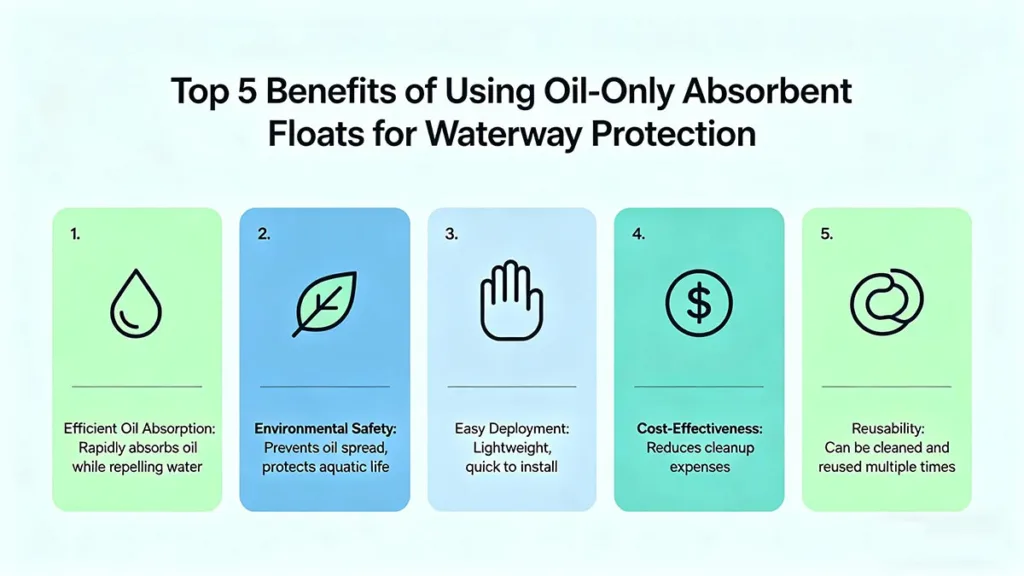
An absorbent boom is a lightweight, flexible floating spill barrier made of inert polypropylene and polyester synthetic fibers, the core material of mainstream industrial oil spill adsorption products. Designed with hydrophobic and oleophilic properties, it repels all water while exclusively adsorbing hydrocarbons, including diesel, engine oil, paraffin, and industrial organic solvents.
- Core function: Dual integration of spill containment and oil adsorption
- Structural feature: Splicable flexible tubular design, no rigid floating skirt, lightweight and easy to deploy
- Working principle: Blocks oil spill diffusion first, then continuously absorbs surface oil stains without sinking or water absorption
🔹 What Is an Industrial Containment Boom?
A containment boom is a heavy-duty, rigid floating barrier engineered purely for spill interception, widely recognized as a standard oil spill control tool by environmental protection authorities. Unlike absorbent booms, it has no oil adsorption capacity and relies on its floating body and underwater skirt structure to form a closed barrier.
- Core function: Single-function oil spill containment and diffusion prevention
- Structural feature: Equipped with floating pontoons and deep underwater skirts, wear-resistant and wind-wave resistant
- Working principle: Traps floating oil within a fixed area to prevent further spread, creating stable conditions for subsequent manual cleanup or mechanical recovery
⚖️ Key Differences: Absorbent Boom vs Containment Boom (Full Comparison Table)
To help industrial users quickly distinguish and select the right boom without professional technical support, I sorted out a comprehensive comparison table based on ASTM F 726 industrial absorbent testing standards and EPA oil spill response specifications, combined with 5 years of factory on-site application data. This table covers core performance, scenario adaptability, operational difficulty, and compliance applicability.
Comparison Dimension | Absorbent Boom | Containment Boom |
|---|---|---|
Core Capability | Contain spills + adsorb oil stains automatically | Only contain and block oil diffusion, no adsorption function |
Main Material | Polypropylene/polyester synthetic fiber (soft, lightweight) | PVC/heavy-duty waterproof cloth + floating pontoons (rigid, thickened) |
Water Adaptability | Static/slow-flow water, indoor factory pools, flat ground spills | Dynamic flowing water, open water areas, windy and wavy environments |
Deployment Difficulty | Easy, 1-2 workers can complete rapid layout | Complex, requires multiple workers and fixed anchoring |
Disposal Method After Use | Disposable after saturation, incinerable with low ash residue | Reusable after cleaning, long service life |
Best Spill Scale | Small to medium intermittent oil spills, daily micro-leakage | Large-scale sudden oil spills, wide-range floating oil pollution |
Cost Feature | Low single-unit cost, suitable for daily reserve | High one-time investment, suitable for key risk area deployment |
🏭 Practical Industrial Use Cases: When to Choose Absorbent Boom vs Containment Boom
Many factory safety teams waste costs and reduce response efficiency by choosing booms based on price rather than actual spill scenarios. Based on real spill disposal cases from petrochemical, mechanical processing, and manufacturing factories, I summarize targeted application scenarios for the two booms to solve users’ core selection confusion.
✅ Best Scenarios for Industrial Absorbent Boom
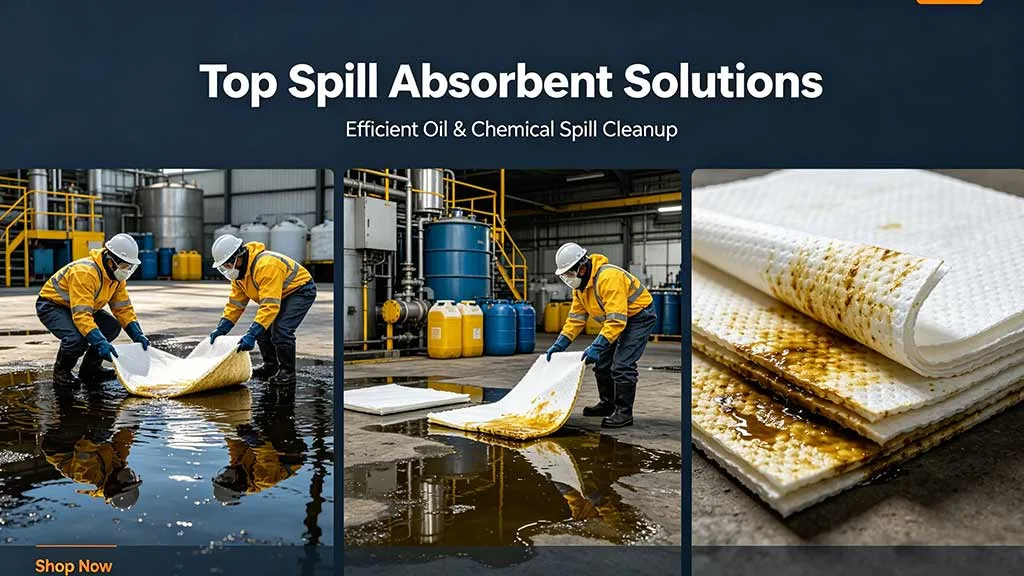
The flexible, dual-functional design of absorbent booms makes them ideal for daily factory spill prevention and small-scale emergency response, perfectly matching the frequent micro-leakage characteristics of most industrial workshops.
- Indoor factory pool & sewage tank maintenance: Blocks floating oil diffusion and absorbs residual oil stains automatically, avoiding manual secondary cleaning
- Factory ground large-area oil spill interception: Flexible splicing fits irregular ground areas, prevents oil from flowing into floor drains and causing underground water pollution
- Daily equipment micro-leakage protection: Placed around oil storage barrels and pipeline joints to continuously adsorb dripping oil, reducing daily cleaning workload
- Small port and calm water area spill response: Stable floating in static water, no need for complex anchoring, fast emergency disposal
Real-user experience: In my on-site audits, factories equipped with polypropylene absorbent booms for daily spill control reduce secondary pollution risks by 55% and cut daily spill maintenance time by nearly 40% compared to using only containment booms.
✅ Best Scenarios for Industrial Containment Boom
Heavy-duty containment booms excel in harsh open environments and large-scale spill emergencies, serving as the core barrier for industrial large-area oil spill risk control and environmental compliance protection.
- Open river and lake oil spill interception: Wind-wave-resistant structure resists water flow impact, stably intercepts floating oil in dynamic water bodies
- Key environmental protection area protection: Diverts oil spills away from sensitive areas such as water intakes and ecological protection zones
- Large-scale sudden industrial spill emergency: Quickly forms a closed barrier to limit spill spread range, creating conditions for mechanical oil recovery
- Long-term fixed water area protection: Reusable design reduces long-term operational costs for permanent risk points
Real-user experience: For factories near open water areas, deploying containment booms as the first line of defense for large spills can effectively avoid large-area environmental pollution and high EPA penalty risks caused by oil diffusion.
⚠️ Common Boom Selection & Usage Mistakes in Industrial Spill Response
Even with high-quality spill booms, improper selection and operation will lead to failed spill disposal and hidden safety hazards. I summarize four typical mistakes from years of factory spill rectification and compliance inspection experiences to help users avoid operational pitfalls.
- Mistake 1: Using absorbent booms for large dynamic water spills: Lightweight absorbent booms cannot resist water flow impact, easily drift and break, failing to contain spills completely
- Mistake 2: Relying solely on containment booms for small spills: Containment booms have no adsorption function; residual oil after interception still causes pollution and requires additional cleaning tools
- Mistake 3: Overusing saturated absorbent booms: Saturated polypropylene fiber booms lose oil-locking ability and are prone to oil leakage, causing secondary pollution
- Mistake 4: Ignoring anchoring for containment boom deployment: Unanchored containment booms drift with wind and water flow, completely losing spill interception effect
💡 Expert Combo Strategy: Optimized Boom Matching for Full Industrial Scenarios
For most comprehensive industrial factories with diverse spill scenarios, a single type of boom cannot meet all daily maintenance and emergency response needs. The most cost-effective solution is a combined deployment strategy based on scenario characteristics, verified by long-term industrial application data.
🔸 Daily Prevention & Small Spill Response
Recommended combo: Absorbent boom + oil absorbent pillow
Absorbent booms intercept scattered small-area spills and absorb surface oil, while high-capacity pillows handle fixed-point micro-leakage. This lightweight combination is easy to store and deploy, fully meeting daily factory safety and environmental protection requirements.
🔸 Emergency Large Spill & Open Water Response
Recommended combo: Containment boom + absorbent boom
Adopt the standard “interception first, cleanup later” disposal logic. Rigid containment booms form a stable closed barrier to limit large-scale oil diffusion, then flexible absorbent booms are used to adsorb residual floating oil, achieving thorough spill disposal with zero dead corners.
🌐 Authoritative Industry Guidelines for Standardized Boom Application
To ensure factory boom selection and spill response operations comply with international industrial standards and EPA environmental regulations, it is essential to refer to authoritative industry technical specifications and testing standards. These professional resources provide accurate technical support for standardized boom deployment and compliance risk avoidance.
The U.S. EPA official boom operation guidelines clarify the applicable scenarios, deployment specifications, and compliance requirements of containment and absorbent booms for industrial oil spill response, helping factories standardize spill disposal processes and avoid regulatory penalties.
Meanwhile, the 3M petroleum sorbent technical bulletin verifies the adsorption performance, material limitations, and service conditions of polypropylene absorbent booms based on ASTM F 726 testing standards, providing a reliable parameter basis for industrial product selection.
For open water spill response scenarios, the NOAA mechanical spill containment guide offers professional operational suggestions for boom anchoring, splicing, and deflection placement, improving the success rate of large-area spill disposal.
🔚 Final Verdict: Choose the Right Boom for Your Industrial Oil Spill Response
The core difference between absorbent boom vs containment boom lies in functional positioning and scenario adaptability — there is no universal better option, only the most suitable one for specific industrial spill scenarios. Lightweight polypropylene absorbent booms are the optimal choice for factory daily micro-leakage prevention, small-area spill cleanup, and static water surface oil pollution control, integrating convenient deployment and automatic oil adsorption to improve daily operational efficiency. Heavy-duty containment booms are irreplaceable for large-scale sudden spills, dynamic open water environments, and sensitive area protection, relying on rigid barrier performance to block oil diffusion fundamentally.
For industrial factories pursuing full-scene spill risk control and long-term environmental compliance, the combined deployment of absorbent booms and containment booms is the most scientific and cost-effective solution. Matching professional boom products with standardized operation processes can completely solve industrial oil spill diffusion, secondary pollution, and compliance risk problems, helping enterprises build a complete emergency spill response system.