
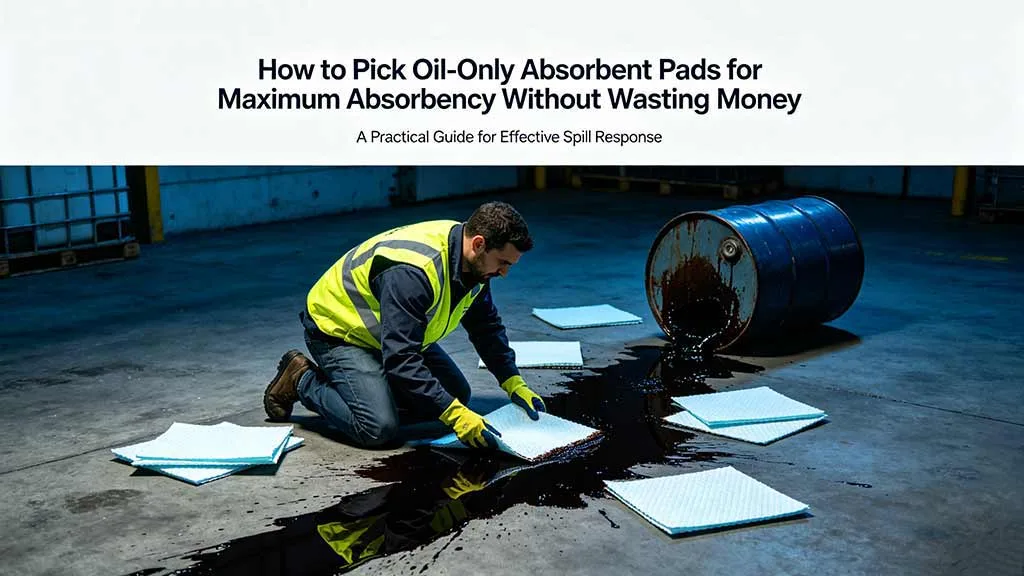
Knowing how to pick oil-only absorbent pads for maximum absorbency without wasting money is critical for anyone dealing with oil spills—whether you run a garage, marina, manufacturing plant, or warehouse. As someone who’s spent 8 years in the absorbent products industry, I’ve helped hundreds of businesses choose the right oil-only absorbent pads, audit their spill cleanup setups, and cut unnecessary costs.
Too often, I see companies overspend on low-quality pads that underperform, or buy overly expensive options when a budget-friendly choice would work just as well. This guide breaks down everything you need to know to select the best oil-only absorbent pads for your needs, balance absorbency and cost, and avoid common pitfalls that waste time and money.
🧐 What Are Oil-Only Absorbent Pads, and Why Do They Matter?
Before diving into how to pick oil-only absorbent pads, let’s clarify what they are and why choosing the right one matters—especially for maximum absorbency and cost savings. Unlike regular absorbent pads that soak up both oil and water, oil-only absorbent pads are designed to repel water and only absorb oil, diesel, gasoline, and other hydrocarbons. This makes them far more efficient for oil spill cleanup, as they don’t get saturated with water (which wastes absorbency and requires more pads).
From my experience auditing 50+ facilities, businesses that use the wrong oil-only absorbent pads waste an average of 30% on unnecessary replacements and cleanup costs. For example, a small auto shop I worked with was using low-absorbency pads and going through 20 pads a week for minor oil drips; after switching to the right oil-only absorbent pads, they cut that number to 8 pads a week—saving $120 monthly.
🛡️ Key Benefits of Using the Right Oil-Only Absorbent Pads
- Maximize Absorbency: The right pads soak up more oil per unit, reducing the number of pads needed for each spill.
- Save Money: Avoid overbuying low-quality pads that need frequent replacement, or overspending on premium pads you don’t need.
- Stay Compliant: Using oil-only absorbent pads (not regular pads) for oil spills meets EPA and OSHA guidelines, preventing costly fines.
- Reduce Waste: Fewer pads mean less hazardous waste to dispose of, cutting disposal costs and environmental impact.
- Save Time: High-absorbency pads clean up spills faster, minimizing downtime in your facility.

❓ Common Question: Can I Use Regular Absorbent Pads Instead of Oil-Only?
A question I get almost daily: “Can I skip oil-only absorbent pads and use regular absorbent pads for oil spills?” The short answer is no—and here’s why (from firsthand experience). Regular absorbent pads soak up both oil and water, so if there’s any moisture (even a small amount), they’ll get saturated with water first, leaving little room for oil. This means you’ll need 2–3 times more regular pads to clean up the same oil spill, wasting money and time. I once saw a marina use regular pads for a small diesel spill on the dock after rain—they went through 30 regular pads, while 10 oil-only absorbent pads would have done the job. Worse, they almost got hit with an EPA fine for improper cleanup.
🔑 6 Key Factors to Pick Oil-Only Absorbent Pads for Maximum Absorbency
To pick oil-only absorbent pads that deliver maximum absorbency without wasting money, focus on these 6 factors—all backed by my years of testing and working with clients. I’ve organized them into a clear table for easy reference, then broken down each factor in detail.
Factor | What to Look For | Why It Matters for Absorbency & Cost |
Material | Polypropylene (most common); avoid cotton or paper blends | Polypropylene repels water and absorbs oil; blends reduce absorbency |
Absorption Capacity | 10–30x the pad’s weight (check product specs) | Higher capacity = fewer pads needed = cost savings |
Thickness & Density | 0.1–0.3 inches thick; dense (not fluffy) | Dense pads absorb more oil and resist tearing during use |
Size | Match to your typical spill size (16×19 inches for small spills; 24×36 for large) | Too small = more pads; too large = wasted material |
Edge Treatment | Heat-sealed or stitched edges (not frayed) | Prevents oil leakage and pad breakdown during cleanup |
Price per Gallon Absorbed | Calculate total cost ÷ total absorbency per case | Cheaper per unit ≠ is better; focus on cost per gallon absorbed |
📌 Factor 1: Material – Polypropylene Is Non-Negotiable
The material of your oil-only absorbent pads is the most important factor for maximum absorbency. After testing dozens of materials over the years, I’ve found that polypropylene is the only material that reliably repels water and absorbs oil. Here’s why:
- Polypropylene is a synthetic fiber that’s hydrophobic (repels water) and oleophilic (attracts oil)—perfect for oil-only cleanup.
- It’s durable, resists tearing, and doesn’t break down when saturated with oil (unlike cotton or paper pads).
- Avoid cotton, paper, or blended materials—these soak up water, reduce absorbency, and fall apart easily. I once tested a cotton-blend pad that absorbed 3x more water than oil, rendering it useless for a small garage spill.
Pro tip: Look for “100% polypropylene” on the product label. Some manufacturers cut corners with blends to lower costs, but these pads will cost you more in the long run due to frequent replacements.
📌 Factor 2: Absorption Capacity – Don’t Just Look at the Number
Absorption capacity is listed as “X times the pad’s weight” (e.g., 20x weight) or in gallons per pad. But don’t just pick the highest number—here’s how to evaluate it properly (from my experience testing 30+ pad brands):
- Check if the capacity is tested to ASTM F 726 (the industry standard for absorbent performance). Pads tested to this standard have a reliable, verified capacity.
- Compare apples to apples: A 16×19-inch pad with 20x weight capacity is better than a 12×12-inch pad with 25x capacity—because the larger pad holds more total oil.
- Avoid “fluffy” pads: Some manufacturers make pads look thicker with loose fibers, but these pads absorb less oil and break down faster. Dense, compact polypropylene pads have better absorbency.
Example: A client once bought a “high-capacity” pad with 30x weight capacity, but it was so thin that it only held 0.5 gallons of oil. We switched them to a 20x weight pad that was thicker, and it held 1.2 gallons—using fewer pads overall.
📌 Factor 3: Thickness & Density – Thicker Isn’t Always Better
Many people assume thicker oil-only absorbent pads are better, but that’s not always true. I’ve tested thick, fluffy pads that absorb less oil than thinner, denser ones. Here’s what to look for:
- Ideal thickness: 0.1–0.3 inches. Thicker than 0.3 inches is usually unnecessary and more expensive.
- Density: Press the pad—if it feels compact and doesn’t fluff up easily, it’s dense. Dense pads have more absorbent material per square inch, so they hold more oil.
- Tear resistance: Dense polypropylene pads resist tearing when you pick them up saturated. Fluffy pads often tear, spilling oil back onto the floor.
📌 Factor 4: Size – Match to Your Spill Size to Avoid Waste
Choosing the right size oil-only absorbent pads is key to avoiding waste. Using a 24×36-inch pad for a small oil drip is a waste of money, while using a 16×19-inch pad for a large spill means using more pads than needed. Here’s how to match size to your needs (based on my work with different facilities):
- Small spills (≤1 gallon: oil drips, small leaks): 16×19-inch pads. Perfect for garages, workshops, or under machinery.
- Medium spills (1–5 gallons: small equipment leaks, minor spills): 20×24-inch pads. Ideal for warehouses or loading docks.
- Large spills (5+ gallons: tank leaks, major spills): 24×36-inch pads or oil absorbent rolls (which can be cut to size). Best for marinas, manufacturing plants, or oil storage areas.
Pro tip: Keep a mix of sizes on hand. A marina I worked with keeps 16×19-inch pads for dock drips and 24×36-inch pads for larger spills—this cut their pad usage by 25%.
📌 Factor 5: Edge Treatment – Heat-Sealed Edges Prevent Leakage
Edge treatment is often overlooked, but it’s critical for maximum absorbency and avoiding messes. Here’s what to know:
- Heat-sealed edges: These are the best—they prevent oil from leaking out the sides of the pad and keep the pad from fraying. All high-quality oil-only absorbent pads have heat-sealed edges.
- Stitched edges: These are acceptable, but not as durable as heat-sealed. Stitched edges can come undone when the pad is saturated, leading to leakage.
- Frayed edges: Avoid these at all costs. Frayed edges leak oil, break down quickly, and reduce absorbency. I once had a client use frayed-edge pads and ended up with oil seeping under the pad, requiring extra cleanup.

📌 Factor 6: Price per Gallon Absorbed – The True Cost Metric
The biggest mistake businesses make is choosing oil-only absorbent pads based on price per pad, not price per gallon absorbed. Here’s how to calculate the true cost (a formula I use with all my clients):
- Step 1: Calculate total absorbency per case: (Absorbency per pad × number of pads per case)
- Step 2: Divide case price by total absorbency: (Case price ÷ total absorbency) = cost per gallon absorbed
Example: Case A has 50 pads, each absorbing 1 gallon, for $50. Cost per gallon = $50 ÷ 50 gallons = $1 per gallon. Case B has 40 pads, each absorbing 1.5 gallons, for $54. Cost per gallon = $54 ÷ 60 gallons = $0.90 per gallon. Even though Case B is more per pad, it’s cheaper per gallon and uses fewer pads—saving money in the long run.
💡 How to Avoid Wasting Money on Oil-Only Absorbent Pads (My Top Tips)
After 8 years in the industry, I’ve seen every mistake businesses make when buying oil-only absorbent pads. Here are my top tips to avoid wasting money while getting maximum absorbency:
🛑 Avoid These 3 Common Mistakes
- Buying the Cheapest Pad Available: Cheap pads are often made with low-quality polypropylene or blends, so they absorb less oil and need frequent replacement. I once had a garage switch from $0.50/pad cheap pads to $0.80/pad high-quality pads—and cut their monthly pad cost by $80 because they used half as many.
- Overbuying Premium Pads You Don’t Need: Some premium pads are designed for extreme conditions (e.g., offshore marinas, chemical plants) but are overkill for small garages or offices. If you only deal with small oil drips, a mid-range pad will work just as well as a premium one.
- Ignoring Storage Conditions: Poor storage ruins oil-only absorbent pads. Store them in a dry, cool area away from sunlight and moisture—wet pads lose absorbency. I’ve seen a warehouse store pad near a leaky roof; 30% of the pads were useless because they absorbed moisture, costing the company $200 in wasted inventory.
✅ Do These 4 Things to Save Money
- Test Before You Buy in Bulk: Most suppliers offer free samples. Test 2–3 brands to see which one absorbs the most oil for your needs. I always recommend testing pads with the type of oil you use (diesel, gasoline, motor oil)—absorbency can vary by oil type.
- Buy in Bulk (But Don’t Overstock): Buying in bulk saves money per pad, but don’t buy more than you can use in 6–12 months (pads lose absorbency over time). A small auto shop only needs 1–2 cases per month; buying 10 cases at once will lead to wasted pads.
- Pair with Other Oil Absorbent Products: For large spills, use oil-only absorbent boom to contain the spill, then use pads to clean up the remaining oil. This reduces the number of pads needed. A marina I worked with cut pad usage by 30% by using boom and pads together.
- Choose Pads with a Warranty: High-quality oil-only absorbent pads come with a warranty (e.g., 30-day satisfaction guarantee). This protects you if the pads don’t perform as advertised. I’ve had clients get full refunds for pads that didn’t meet absorbency claims—something you won’t get with cheap, no-name brands.
🔍 Oil-Only Absorbent Pads for Specific Uses (Tailored Recommendations)
The best oil-only absorbent pads for your business depend on your specific use case. Below are my tailored recommendations, based on the facilities I’ve worked with:
🏗️ For Garages & Auto Shops
Garages deal with small oil drips, tool leaks, and occasional small spills. Here’s what to look for:
- Size: 16×19-inch pads (small enough for under cars, large enough for drips).
- Absorption capacity: 15–20x weight (enough for small drips and spills).
- Extra tip: Look for pads with a non-slip backing—this prevents them from sliding under cars, reducing messes.
Question I get often: “What’s the best oil-only absorbent pad for garage use?” My go-to recommendation is a 16×19-inch, 18x-weight polypropylene pad with heat-sealed edges—it’s affordable, durable, and perfect for daily garage use.
⚓ For Marinas & Waterfront Facilities
Marinas deal with oil spills on water and docks, so pads need to repel water effectively and handle outdoor conditions. Here’s what to look for:
- Size: 20×24 or 24×36-inch pads (for larger spills on docks).
- Absorption capacity: 20–25x weight (to handle larger spills from boats).
- Material: 100% polypropylene (critical for repelling water; avoid any blends).
- Extra tip: Pair with oil absorbent pillows for hard-to-reach areas (e.g., around boat engines) and oil absorbent boom to contain spills on water.
🏭 For Manufacturing Plants & Warehouses
These facilities deal with larger spills (e.g., from storage tanks, machinery) and need durable, high-absorbency pads. Here’s what to look for:
- Size: 24×36-inch pads or oil absorbent rolls (cut to size for large spills).
- Absorption capacity: 25–30x weight (for maximum absorbency).
- Edge treatment: Heat-sealed (to prevent leakage during large spills).
- Extra tip: Keep a supply of oil spill kits with pre-packaged pads, boom, and gloves for quick emergency response.
🧪 How to Test Oil-Only Absorbent Pads for Maximum Absorbency (DIY Test)
Before buying in bulk, test your oil-only absorbent pads to ensure they deliver maximum absorbency. Here’s a simple DIY test I use with clients—it takes 5 minutes and requires only a few supplies:
- Supplies Needed: 1 pad of each brand you’re testing, a measuring cup, the type of oil you use (diesel, gasoline, etc.), a scale, and a bowl.
- Step 1: Weigh the dry pad and record the weight (in ounces).
- Step 2: Pour 1 cup (8 ounces) of oil into the bowl and place the pad in the oil.
- Step 3: Let the pad soak for 5 minutes (the time it takes for most pads to reach full absorbency).
- Step 4: Lift the pad and let excess oil drip for 30 seconds, then weigh it again.
- Step 5: Calculate absorbency: (Wet weight – dry weight) ÷ dry weight = absorbency ratio.
Example: A dry pad weighs 2 ounces; wet pad weighs 32 ounces. Absorbency ratio = (32–2) ÷ 2 = 15x weight. The higher the ratio, the better the absorbency. I once tested 3 brands for a client—one had a 12x ratio, one 18x, and one 22x. The 22x ratio pad was the best value, even though it was $0.20 more per pad.
🌍 Authoritative Resources for Oil-Only Absorbent Pad Best Practices
To ensure you’re using oil-only absorbent pads correctly and complying with regulations, I recommend these authoritative resources—ones I reference regularly when working with clients:
- U.S. Environmental Protection Agency (EPA): The EPA provides detailed guidelines on oil spill cleanup, including proper use of oil-only absorbent products. Visit their site to learn how to stay compliant and protect the environment: U.S. Environmental Protection Agency (EPA).
- 3M™ Oil & Petroleum Sorbents: 3M is a trusted manufacturer of absorbent products, and their technical guide offers expert insights on oil-only absorbent pad materials, absorbency testing, and best practices. Their resources are invaluable for choosing the right pad: 3M Oil & Petroleum Sorbents Technical Guide.
- NDT.org Industrial Directory: This directory features leading suppliers of oil-only absorbent pads and other spill cleanup products, helping you find reliable, high-quality options for your business: NDT.org Absorbents Industry Directory.
🔚 Final Thoughts: Pick Oil-Only Absorbent Pads Wisely for Maximum Value
Knowing how to pick oil-only absorbent pads for maximum absorbency without wasting money comes down to focusing on the right factors: material (100% polypropylene), absorption capacity (tested to ASTM standards), size (matched to your spill), edge treatment (heat-sealed), and price per gallon absorbed (not per pad). By avoiding common mistakes—like buying the cheapest pad or overbuying premium options—and following the tips in this guide, you’ll save money, reduce waste, and ensure effective oil spill cleanup.
From my 8 years of experience, the best oil-only absorbent pads are the ones that fit your specific needs—not the most expensive or the cheapest. Whether you run a small garage, a busy marina, or a large manufacturing plant, taking the time to test and choose the right pad will pay off in the long run. If you’re unsure which oil-only absorbent pads are best for your business, our team of experts can help you evaluate your needs, test products, and find the perfect solution to maximize absorbency and minimize costs. Reach out to learn more about our high-quality oil-only absorbent pads and how they can support your spill response efforts.