🌊 Introduction: Why Boom Selection Matters for Oil Spill Control
Oil absorbent booms and spill containment booms are foundational tools for professional oil spill control across marine, industrial, and commercial sites. Most facility managers and safety officers struggle to distinguish these two similar-looking products, leading to improper deployment, inefficient spill cleanup, and unneeded environmental or financial losses.
Many businesses mistakenly use one boom type as a replacement for the other, unaware that each serves unique functional purposes and fits distinct spill scenarios. Choosing the wrong boom fails to stop spill spread or remove residual oil, resulting in prolonged pollution, regulatory non-compliance, and higher remediation costs.
This detailed guide breaks down the core differences between oil absorbent booms and spill containment booms, clarifies their respective applications, and explains how to combine them for a complete, high-efficiency spill response strategy tailored to industrial and marine needs.
🛡️ What Are Oil Absorbent Booms? Core Definition & Features
Core Functional Positioning
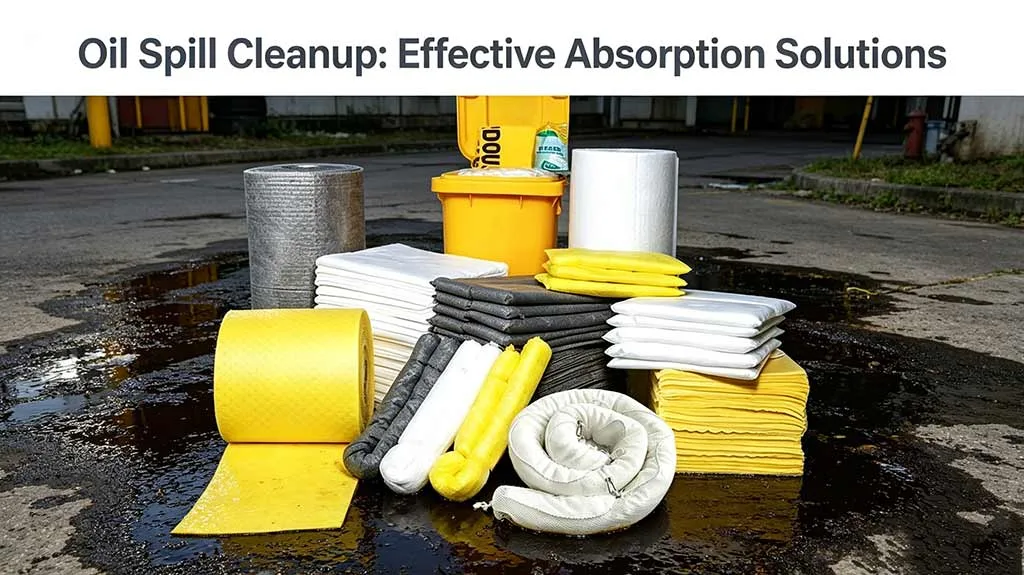
Oil absorbent booms are specialized post-spill cleanup tools designed primarily to remove existing oil and hydrocarbon liquids from water surfaces. Unlike barrier-focused products, their core value lies in active oil adsorption rather than passive spill blocking.
These booms target finished spill incidents, efficiently clearing floating oil films and scattered oil residues that standard barriers cannot eliminate. They serve as the final cleanup step to restore water environment safety after spill containment.
Material & Structural Design
- Premium raw material: Made of high-purity polypropylene synthetic fiber, featuring inherent hydrophobic and oleophilic properties
- Lightweight structure: Cylindrical hollow design filled with dense absorbent fiber, wrapped in durable mesh fabric
- Flexible connection: Equipped with standard connecting buckles for endless splicing to cover large water areas
- No water absorption: Repels pure water completely while absorbing multiple times its weight in oil and petroleum products
Typical Application Scenarios
Oil absorbent booms excel in scenarios where oil has already spread on water surfaces and requires thorough removal. They adapt to multiple conventional spill environments with stable adsorption performance.
- Marine environments: Ocean, lake, and harbor floating oil cleanup after spill interception
- Industrial sites: Factory water ponds, fuel storage areas, and mechanical oil leakage cleanup
- Transportation scenarios: Road and railway oil spill residue removal near water accumulation areas
🚧 What Are Spill Containment Booms? Core Definition & Features
Core Functional Positioning
Spill containment booms are pre-emptive barrier tools focused on preventing oil spill diffusion. Their core function is to isolate polluted water areas and control spill ranges, rather than absorbing oil pollutants.
These booms act as the first line of defense in spill response, blocking floating oil from spreading to sensitive ecological zones, shorelines, and clean water areas to minimize pollution scope.
Material & Structural Design
- Durable raw material: Adopts high-strength PVC or vinyl material with excellent weather and corrosion resistance
- Professional floating structure: Top floating device ensures stable water surface suspension, bottom weighted skirt prevents underflow oil escape
- Rugged build: Tear-resistant and wave-resistant structure, suitable for long-term open water deployment
- Non-absorbent design: No oil adsorption function, purely relies on a physical barrier to limit spill spread
Typical Application Scenarios
Spill containment booms are mainly used for pre-spill prevention and emergency interception to control spill diffusion scope. They are essential for large-scale and open water spill risk management.
- Open water protection: Rivers, lakes, and offshore waters to block sudden oil spill spread
- Sensitive area isolation: Shorelines, marine habitats, and ecological protection zones isolation
- Spill diversion: Guide floating oil to fixed areas for centralized subsequent cleanup
📊 Direct Comparison: Oil Absorbent Booms vs Spill Containment Booms
The fundamental differences between the two boom types lie in functional positioning, material attributes, and application timing. The following intuitive comparison helps quickly clarify selection standards for different spill scenarios.
Comparison Dimension | Oil Absorbent Booms | Spill Containment Booms |
Core Purpose | Absorb and remove existing oil spills on water | Block and control oil spill diffusion range |
Main Material | Polypropylene absorbent synthetic fiber | PVC, vinyl durable waterproof material |
Key Performance | Oil-water separation, high oil adsorption capacity | Wave resistance, stable barrier, anti-escape skirt design |
Deployment Timing | After spill containment, for residual oil cleanup | At spill occurrence, for emergency diffusion control |
Reusability | Reusable after cleaning and drying | Long-term reusable with no functional attenuation |
Best Fit Scenarios | Small-medium spills, residual oil film cleanup | Large open water spills, sensitive area protection |
⚙️ Why Dual-Boom Combination Delivers Optimal Spill Control Results
Many industrial facility operators overlook the complementary value of oil absorbent booms and spill containment booms. Single-type boom deployment can only solve part of spill problems, while paired use achieves full-process closed-loop spill management.
Complete Spill Response Workflow
A standardized professional spill response follows a clear two-step boom deployment logic, which maximizes disposal efficiency and minimizes pollution losses.
- First step: Containment interception. Deploy spill containment booms immediately after a spill occurs to form a closed barrier, preventing oil from spreading to clean water and ecologically sensitive areas
- Second step: Thorough cleanup. After limiting the spill range, lay oil absorbent booms in the enclosed area to adsorb floating oil and residual oil films for complete cleanup
Core Advantages of Combined Use
- Full risk control: Covers both spill diffusion prevention and pollutant removal to avoid incomplete disposal
- Improved cleanup efficiency: Centralized oil gathering via containment booms enhances absorbent boom oil collection effects
- Reduced comprehensive costs: Avoids secondary pollution remediation expenses and regulatory fines caused by incomplete spill treatment
- Compliance guarantee: Meets industrial safety and environmental protection standards for standardized spill response
🏭 Scenario-Based Boom Selection Guide for Industrial Facilities
1. Oil Storage & Refinery Facilities
Oil storage bases and refineries face risks of large-scale tank leakage and pipeline rupture spills. These sites require dual configuration of containment and absorbent booms for full-cycle risk prevention.
Deploy reinforced spill containment booms around storage ponds for long-term fixed isolation. Equip portable polypropylene oil absorbent booms for emergency residual oil cleanup after spill interception to ensure zero residual pollution.
2. Port & Coastal Terminal Sites
Coastal terminals and shipping berths have complex open water environments with high wind and wave interference, putting forward high requirements for boom stability and durability.
High-strength spill containment booms are preferred for ship operation area enclosure to block fuel leakage diffusion. Matched lightweight oil absorbent booms handle daily scattered oil films to protect coastal ecological environments.
3. Chemical Manufacturing Plants
Chemical plants often face mixed spills of oil-based auxiliary materials and weak corrosive reagents, requiring adaptive boom products.
Containment booms isolate leakage areas to prevent mixed pollutants from spreading. Modified polypropylene oil absorbent booms adapt to complex mixed fluid environments for targeted adsorption and cleanup.
4. Industrial Park & Municipal Water Systems
Industrial parks and municipal landscape waters suffer from long-term scattered oil pollution from equipment operation and surface runoff, which easily accumulates into hidden pollution hazards.
Regularly deploy small-scale containment booms for regional isolation. Use conventional oil absorbent booms for periodic floating oil cleaning to maintain long-term water environment compliance.
✅ Common Mistakes in Boom Selection & Deployment
Improper boom selection and deployment are the main causes of poor spill control effects. Summarized common industry mistakes help facilities optimize spill response strategies.
- Single product reliance: Only using absorbent booms leads to uncontrollable spill spread; only using containment booms leaves residual oil pollution
- Scenario mismatching: Deploying lightweight absorbent booms in harsh open water causes tearing and failure
- Deployment sequence error: Cleaning first, then containing, leads to expanded spill scope and increased disposal difficulty
- Ignoring maintenance: Long-term unused booms age and fail, affecting emergency response effectiveness
🔧 Compliance & Maintenance Tips for Long-Term Boom Service
Qualified boom configuration and standardized maintenance are key to meeting EPA and OSHA industrial spill safety standards, ensuring stable product performance and long service life.
Compliance Configuration Requirements
All industrial spill booms must meet federal environmental and safety specifications. Spill containment booms need stable barrier performance to comply with stormwater pollution prevention rules.
Polypropylene oil absorbent booms must pass national material testing to ensure no fiber shedding or secondary water pollution, meeting industrial environmental protection compliance standards.
Daily Maintenance & Preservation
- Regular inspection: Check boom integrity, connector tightness, and floating stability every quarter
- Post-use cleaning: Rinse absorbent booms with clean water and dry naturally for repeated use
- Standard storage: Store booms in cool and ventilated environments to avoid UV aging and corrosive damage
- Timely replacement: Update aged and damaged booms to eliminate emergency response hidden dangers
🔗 Authoritative Industry Resources for Spill Boom Compliance
Enterprise safety managers can refer to official authoritative platforms to update spill control standards, verify product compliance, and standardize on-site boom deployment processes.
Refer to professional oil spill containment equipment specifications and open water boom deployment guidelines via the U.S. EPA official environmental management portal to optimize facility spill prevention systems.
Access workplace spill response safety operation norms and staff training standards through the OSHA occupational safety standard database to standardize team emergency disposal capabilities.
Check industrial polypropylene material performance benchmarks and product quality acceptance criteria on the ANSI national standardization official website to screen qualified spill boom products.
🏁 Conclusion: Optimize Spill Control With Scientific Boom Selection
Oil absorbent booms and spill containment booms are irreplaceable core tools for modern industrial and marine oil spill control, with distinct functions and complementary advantages. Clarifying their key differences is the premise of building an efficient spill response system.
Spill containment booms act as the first line of defense to block spill diffusion, while oil absorbent booms serve as the core cleanup tool to eliminate residual oil pollution. Scientific matching and combined deployment of the two boom types can effectively reduce ecological damage, avoid regulatory penalties, and cut enterprise spill management costs.
For industrial and marine facilities, standardized boom selection, deployment, and maintenance are not only basic requirements for environmental compliance but also key measures to protect workplace safety and ecological resources. Choosing high-quality polypropylene oil absorbent booms and durable containment booms helps enterprises achieve full-cycle, compliant, and efficient oil spill risk control.
If you need scenario-customized spill boom matching solutions, on-site spill risk assessment, or professional deployment guidance, contact our technical team to obtain one-stop industrial spill containment support.